Galactus DB vs Memgraph.
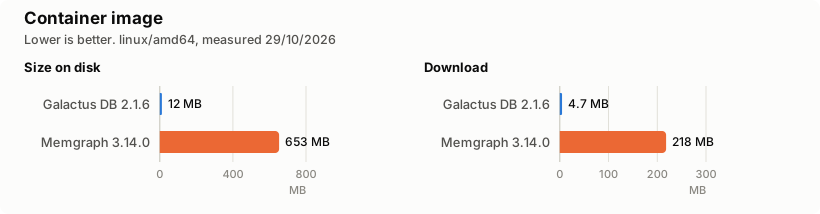
Both speak Cypher over Bolt and answer in well under a millisecond. Galactus DB does it in less than half the memory, from an image a fiftieth of the size, and opens large graphs straight from disk.
Measured side by side.
We sent the same queries over the same graph to both servers, through the same Python client on the same machine. The graph had 100,000 people, 200,000 relationships and an index on the person ID. Each container had 8 CPUs and 8 GB of RAM. We measured Galactus DB 2.1.6 and Memgraph 3.14.0 Community, each on its default settings, on 29 October 2026 on an Intel Core i9-13900K. Every answer was checked to match.
| Workload | Galactus DB | Memgraph |
|---|---|---|
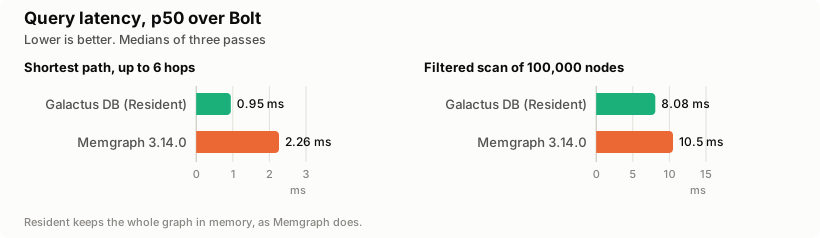
| Shortest path, up to 6 hops, p50 | 0.95 ms (Resident), 1.23 ms (Paged) | 2.26 ms |
| Filtered scan of 100,000 nodes, p50 | 8.1 ms (Resident) | 10.5 ms |
| Index lookup, p95 | 0.78 ms (Paged) | 1.11 ms |
| Index lookup, p50 | 0.51 ms (Resident) | 0.50 ms |
| Two-hop traversal, p50 | 0.52 ms (Resident) | 0.48 ms |
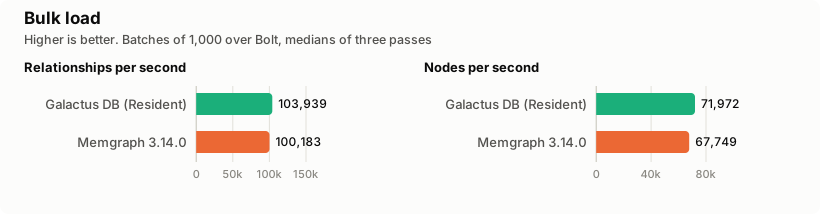
| Bulk load, relationships per second | 103,900 (Resident) | 100,200 |
| Bulk load, nodes per second | 72,000 (Resident) | 67,700 |
| 64 concurrent readers, lookups per second | 3,840 (Paged) | 3,660 |
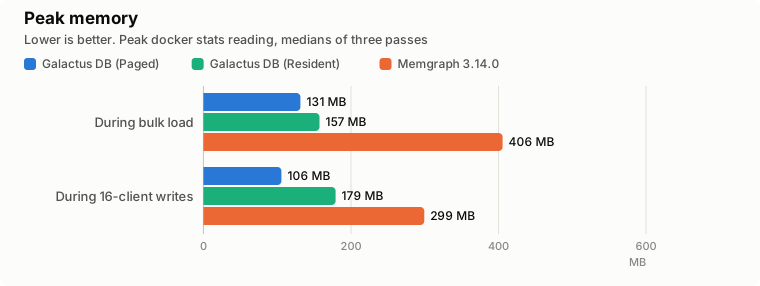
| Peak memory during bulk load | 131 MB (Paged) | 406 MB |
| Peak memory during 16-client writes | 106 MB (Paged) | 299 MB |
| Container image | 12 MB | 653 MB |
Shortest paths came back in less than half the time, and lookups and two-hop traversals stayed level, well under a millisecond. Galactus DB did the same work in a third of Memgraph's memory. Both servers ran their default durability. Galactus DB syncs its commit log every 50 ms, and Memgraph writes a write-ahead log with periodic snapshots. Memgraph has no shortestPath() function, so its query used breadth-first expansion (*BFS ..6), which returned the same paths.
Large graphs open straight from disk.
Galactus DB 2 keeps everything in one place. Records, relationships, properties and every index are stored in checksummed 8 KiB pages, published one complete generation at a time. The commit log holds only the latest writes, until the pages take them in. On start-up, a database reads its latest checkpoint and replays that short log, so nothing has to be loaded into memory or rebuilt first.
Memgraph keeps the graph in memory and makes it durable with a write-ahead log and periodic full snapshots. Its documentation describes recovery in three steps: load the latest snapshot, replay the write-ahead log written since, and rebuild indexes. So start-up grows with the graph.
Galactus DB 2.1.6, Paged engine, measured on 29 October 2026 on the same machine and limits as above, with three passes of each. The time includes Docker starting the container and opening a new Bolt connection.
| Galactus DB | Memgraph | |
|---|---|---|
| Query language and protocol | Cypher over Bolt 4.4 and 5.0–5.4, with documented coverage | Cypher over Bolt |
| Drivers | Neo4j drivers, plus open source drivers (Apache-2.0) for C#, Rust, Java, Go, Node, C++ and Python | Neo4j drivers |
| Storage | Chosen per database: Paged (the default) keeps the pages in use in memory, and Resident keeps the whole graph in RAM | In memory, set per instance. Its documentation calls the on-disk mode experimental |
| Graphs larger than memory | The default engine, in production: a 574 MB database served from a 16 MiB cache | On-disk mode, without replication |
| Durability | Checksummed pages, checked on every read, with a short commit log | Write-ahead log and periodic full snapshots |
| Users, roles and per-database grants | Every edition, Community included | Enterprise |
| Several databases on one server | Three in Community, any number in Commercial | Enterprise |
| Prometheus metrics | Every edition | Enterprise |
| Change data capture | Built in: change streams with before-values, and subscriptions with triggers, at-least-once delivery and dead letters | Triggers, and stream connectors for Kafka, Pulsar and Redpanda |
| Graph algorithms | Built in: centrality, communities, similarity, FastRP, pathfinding | MAGE library |
| Free edition | Community: any use, including production, on any number of cores | Community Edition under the Business Source License 1.1 |
| Paid pricing | Published: $400 (€370, £320) per core, per instance, per year | Through sales |
Choose Galactus DB when…
- You want in-memory speed with a fraction of the RAM.
- Restarts, upgrades and failover should be quick whatever the size of the graph.
- The graph will outgrow memory and still needs to serve production traffic.
- You want users, roles, several databases and metrics in the free edition.
- Finance wants a published price before the evaluation starts.
What you can leave out
- Sizing the server for the whole graph plus snapshot headroom.
- A 650 MB image to scan, ship and patch.
- A sales call to learn the price.
- Third-party runtime packages in the drivers.
Questions
Is Galactus DB faster than Memgraph?
In our side-by-side run, Galactus DB found shortest paths in less than half Memgraph's time (0.95 ms against 2.26 ms) and scanned 100,000 nodes faster (8.1 ms against 10.5 ms). It matched Memgraph on index lookups and two-hop traversals, all well under a millisecond, while using less than half the memory.
Does Galactus DB keep the whole graph in memory like Memgraph?
When you want it to. Each database chooses its engine. Resident keeps the whole graph in RAM. Paged, the default, keeps the pages in use in memory inside one budget you set and opens straight from disk. One server can run both.
How long does a large graph take to start?
A Paged database opens from its latest checkpoint and replays only the short commit log behind it, so nothing is loaded or rebuilt first. With 2 million nodes and 4 million relationships, Galactus DB answered its first query 0.8 s after the container started, including the container's own start-up. That held after a clean stop and after a crash.
Can I use my Memgraph drivers and queries?
Galactus DB speaks Cypher over Bolt 4.4 and 5.0–5.4, so the Neo4j drivers your application uses with Memgraph connect to it too. Most read and write queries carry over as written; check anything unusual against the compatibility guide.
How is Galactus DB licensed?
Galactus DB Community is free for any use, including production, on any number of cores with three active user databases. Users and roles, TLS and Prometheus metrics are included. Commercial adds any number of databases and native backup and restore at a published $400 (€370, £320) per core, per instance, per year. The drivers are open source under Apache-2.0.
Memgraph is a trademark of Memgraph Ltd. Galactus DB is not affiliated with Memgraph Ltd. Memgraph details are from its public documentation and pricing pages as read on 29 October 2026; check the current Memgraph documentation for your version.
Measure it on your own workload.
Community is free for any use and needs no account or licence key. Bring your queries, or a Neo4j dump, and see how they run.