What you are looking at
A coding agent has a question about its own codebase: what controls how long snapshots are kept? Instead of pasting files into a large model, it asks the graph. Nine chapters follow that question from source code to a merged change.
- Ingest. iKode parses every file into chunks along the syntax tree. Each struct, function and method becomes a node; calls, references and tests become edges.
- Embed. A small open model summarises each chunk, and Harrier 0.6B or Gemma Embedding 2 turns it into a vector stored on the node. Similar code lands together in meaning space.
- Search. The question is embedded by the same model. Galactus DB's vector index hops from coarse layers to fine ones and cosine similarity keeps the closest 24.
- Decide. Laya and Inclined, our decision models built on Qwen 3.8, read each candidate against the question and keep only what answers it.
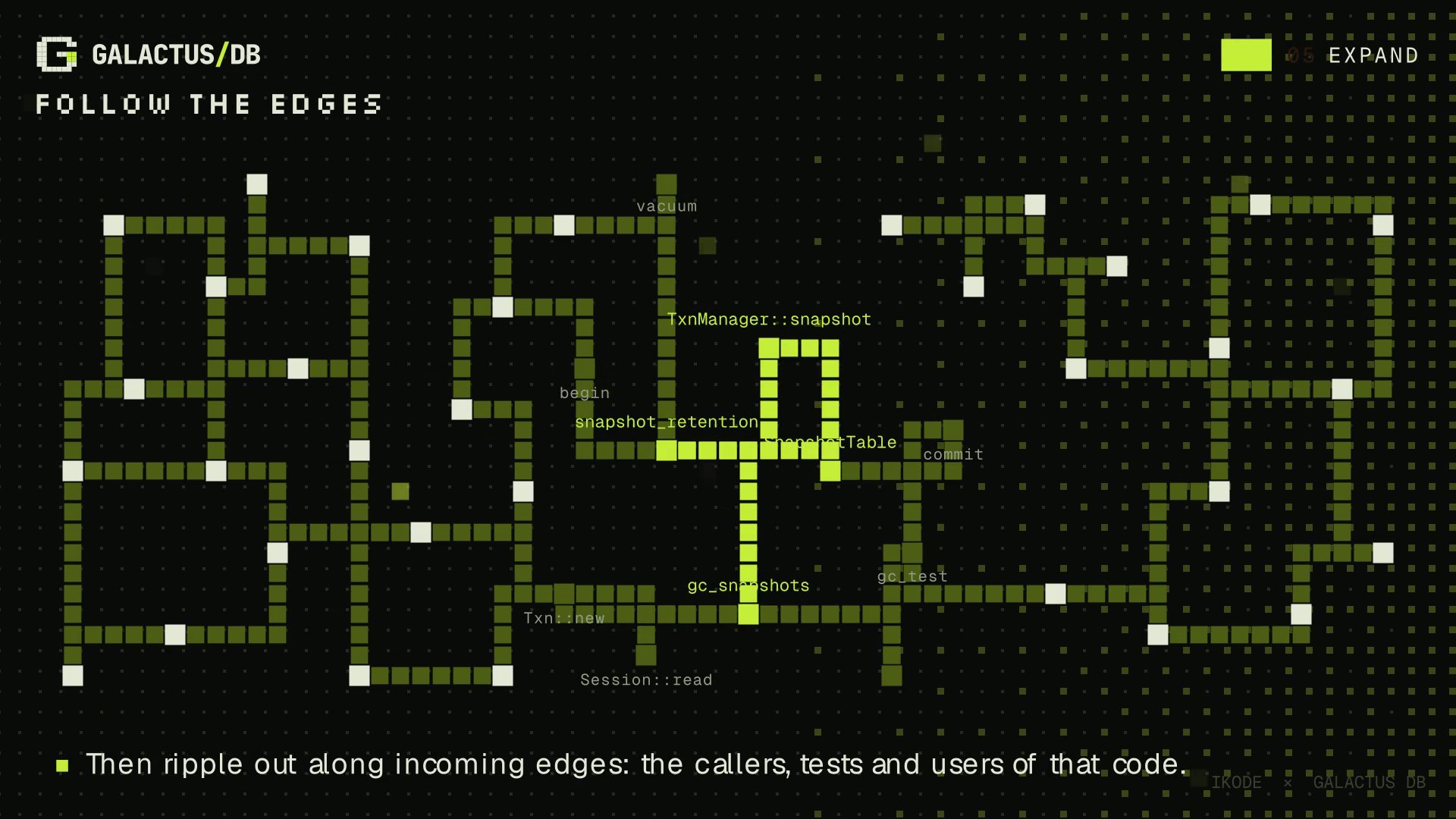
- Expand. The graph shows how the kept chunks are wired together, and which callers and tests a change would touch. That subgraph becomes the brief.
- Hand off. Qwen 3.8 27B, or a frontier model, gets names, paths, line ranges and edges instead of whole files, and answers with the exact change.
- Branches. Main is indexed once. Each branch stores only what it changed, linked to the code it replaces, so many agents can work at once.
- Gates. Every change runs the quality-gate tests and the Galactus benchmark against main. A regression blocks the merge.
- Loop. Only changed chunks are re-embedded, and the next question starts straight away. Galactus helps build Galactus.
The animation is an illustration: the code, scores and figures are made up, and nothing on this page connects to a database.
Things to try
- Pick a chapter from the bar under the scene, or let it run through all nine.
- Hand off is the one to watch if you pay for tokens: compare the two context windows.
- Branches switches the same graph between
main,feat/mvccandperf/clock-cache.